Test Purpose and Engineering Requirements
MIL-STD-810H temperature testing focuses on:
High temperature operational and storage performance validation
Low temperature cold-start and material brittleness assessment
Thermal stress cycling and failure acceleration
Component-level and system-level reliability verification
Typical test ranges:
High temperature: up to +70°C ~ +85°C (application dependent)
Low temperature: down to -40°C ~ -55°C
TestEQ MIL-STD-810H Temperature Test Chamber Solution
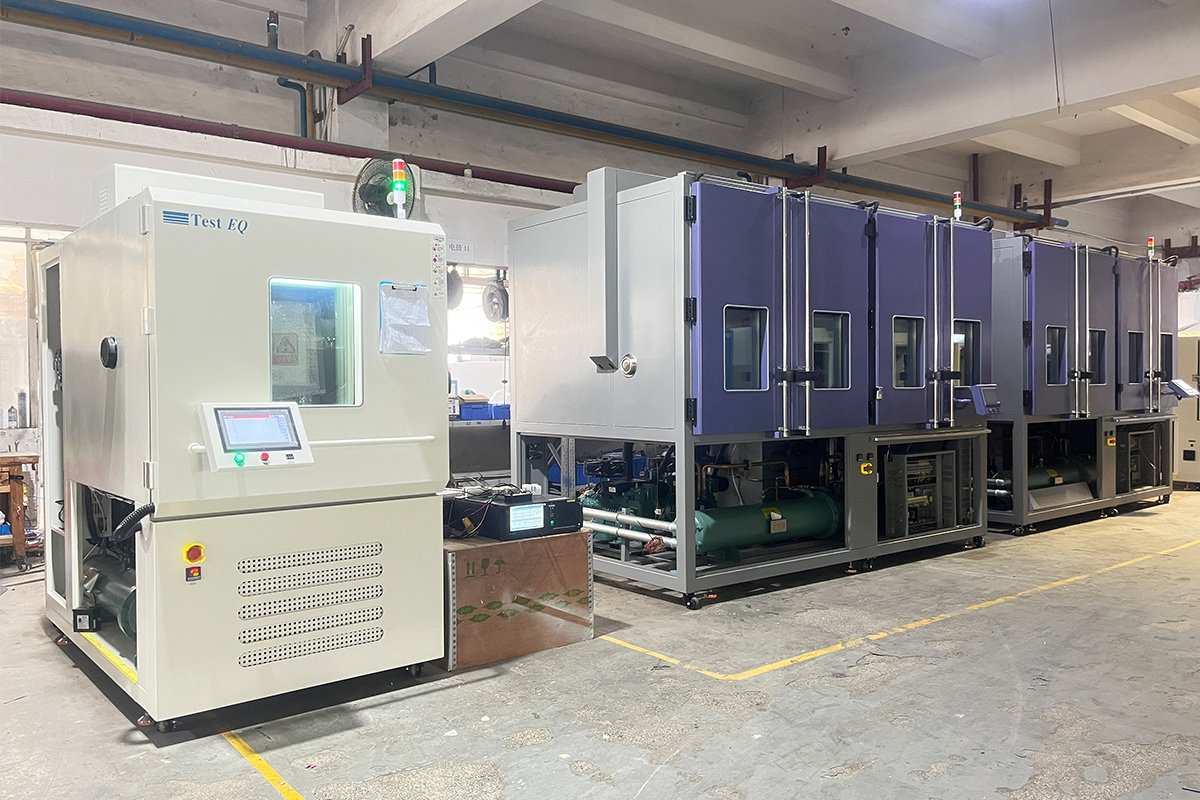
TestEQ environmental test chambers are engineered for precise MIL-STD-810H compliance simulation, supporting stable thermal ramp control, uniform airflow distribution, and long-duration reliability testing.
Key capabilities:
Temperature range: -70°C to +180°C
Control accuracy: ±0.1°C–±1.0°C
Rapid thermal transition capability
Programmable multi-stage test profiles
Data logging for audit and certification traceability
These systems are widely used in defense electronics, satellite components, EV battery systems, and semiconductor validation labs.
MIL-STD-810H vs IEC 60068 Temperature Test Overview
In environmental reliability engineering, MIL-STD-810H and IEC 60068 are two of the most widely used temperature testing frameworks. However, they serve different engineering objectives:
MIL-STD-810H → Military-grade ruggedness validation
IEC 60068 → Industrial product reliability standardization
Understanding the differences is critical for selecting the correct environmental test chamber system and avoiding over- or under-specification in qualification testing.
Temperature Test Method Differences
| Item | MIL-STD-810H | IEC 60068 |
|---|---|---|
| Test Philosophy | Real-world simulation | Laboratory standardization |
| Temperature Range | Application-driven extreme | Defined standardized levels |
| Test Profile | Flexible, mission-based | Fixed test procedures |
| Duration | Often longer field simulation | Defined cycles/time |
| Pass Criteria | Functional mission success | Specification compliance |
Standard Test Procedure
Pre-conditioning of sample at ambient environment
High temperature exposure (steady state or cyclic)
Functional performance verification under load
Low temperature exposure and cold-start test
Post-test inspection (deformation, drift, failure analysis)
This process ensures that product reliability is validated across full thermal stress boundaries.
Application Industries
Aerospace & defense electronics
Automotive ECU & battery systems
Semiconductor & chip packaging
Communication infrastructure equipment
Renewable energy control systems
TestEQ Engineering Advantage
TestEQ environmental chambers support dual-standard testing architecture, allowing laboratories to run both MIL-STD-810H and IEC 60068 profiles without hardware change.
Key advantages:
Unified thermal control system
Multi-standard programmable profiles
Stable long-cycle reliability testing
OEM customization for research labs and factories
This reduces equipment cost while increasing test coverage.
FAQ – MIL-STD-810H Temperature Test
1. What is MIL-STD-810H temperature test used for?
MIL-STD-810H temperature testing is used to evaluate how equipment performs under extreme high and low temperature conditions. It is widely applied in aerospace, defense, automotive, and electronic systems to ensure operational reliability in real-world environments.
2. What temperature range is typically required in MIL-STD-810H testing?
The standard does not define a fixed range, but common test conditions include:
High temperature: +70°C to +85°C
Low temperature: -40°C to -55°C
Actual values depend on product specification and deployment environment.
3. What is the difference between operational and storage temperature tests?
Operational tests evaluate system performance while the product is running under extreme temperatures.
Storage tests evaluate material stability and structural integrity when the product is not powered but exposed to thermal stress.
4. What equipment is required for MIL-STD-810H temperature testing?
A programmable environmental test chamber is required, capable of:
Stable high/low temperature control
Thermal cycling simulation
Precise temperature ramp rate control
Long-duration continuous operation
TestEQ provides dedicated environmental simulation chambers designed for these requirements.
5. How long does a MIL-STD-810H temperature test take?
Test duration varies depending on product type and test profile. It can range from several hours (quick validation) to several days or weeks (full qualification and reliability testing).
6. Can MIL-STD-810H temperature testing be combined with humidity or vibration tests?
Yes. In advanced reliability validation programs, temperature testing is often combined with:
Humidity (IEC 60068 / THB testing)
Vibration testing
Thermal cycling stress testing
This helps simulate real-world multi-factor environmental stress conditions.
Internal Link Modules
Recommended Equipment
Provides highly stable combined temperature and humidity simulation for MIL-STD-810H environmental stress screening.
Widely used in reliability validation of electronics, automotive components, and aerospace systems under long-term climate exposure conditions.
Designed for rapid extreme temperature transition testing between hot and cold zones.
Ideal for detecting material fatigue, solder joint failure, and structural stress under MIL-STD thermal shock conditions.
Related Standards
Internationally recognized baseline standard for environmental reliability testing.
Defines temperature, humidity, vibration, and combined stress test methods widely adopted in industrial qualification and product certification.
Semiconductor-focused reliability standard for thermal cycling and accelerated stress testing.
Commonly used in chip packaging, IC validation, and electronic component failure analysis under repeated thermal load conditions.
Technical Resources
Engineering selection guide for environmental test chambers based on temperature range, ramp rate, test standard, and application industry.
Helps procurement engineers and lab planners select the correct configuration for MIL-STD, IEC, and JEDEC compliance testing.
Technical comparison of thermal cycling and temperature cycling methodologies.
Explains differences in stress mechanism, failure modes, and application scenarios for reliability testing program design.
CTA:
Looking for MIL-STD-810H compliant temperature test systems?
TestEQ provides engineering-grade environmental simulation chambers for aerospace, automotive, semiconductor, and defense applications.
Send us your test requirements and receive a free engineering proposal, including:
Chamber configuration recommendation
Temperature range & performance matching
Test standard compliance mapping (MIL-STD-810H / IEC 60068)
Delivery and integration plan
"Start your project with TestEQ today" reduce testing uncertainty before production.